
Five ancient chapels,
a spiritual journey
between nature and history
The Parish of Sant’Orso, in Cogne, invites you to embark on a beautiful cultural and spiritual journey. Starting from the parish church of Sant’Orso, you can explore the five other ancient chapels.
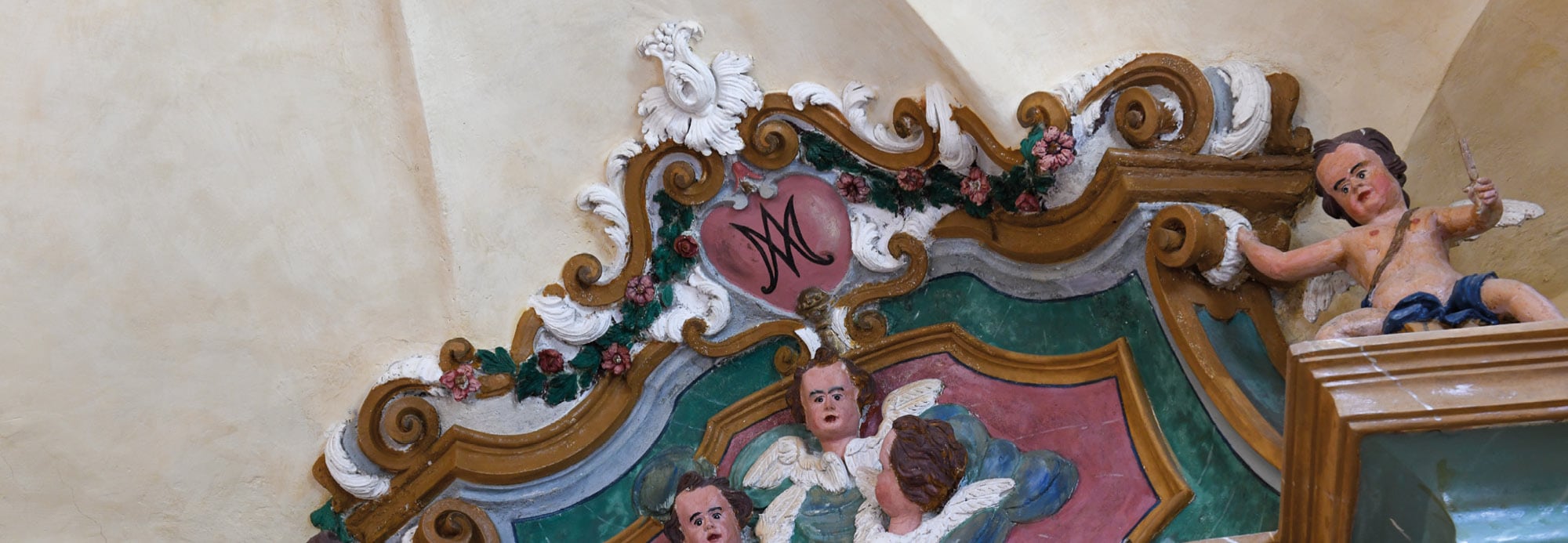
A shared project
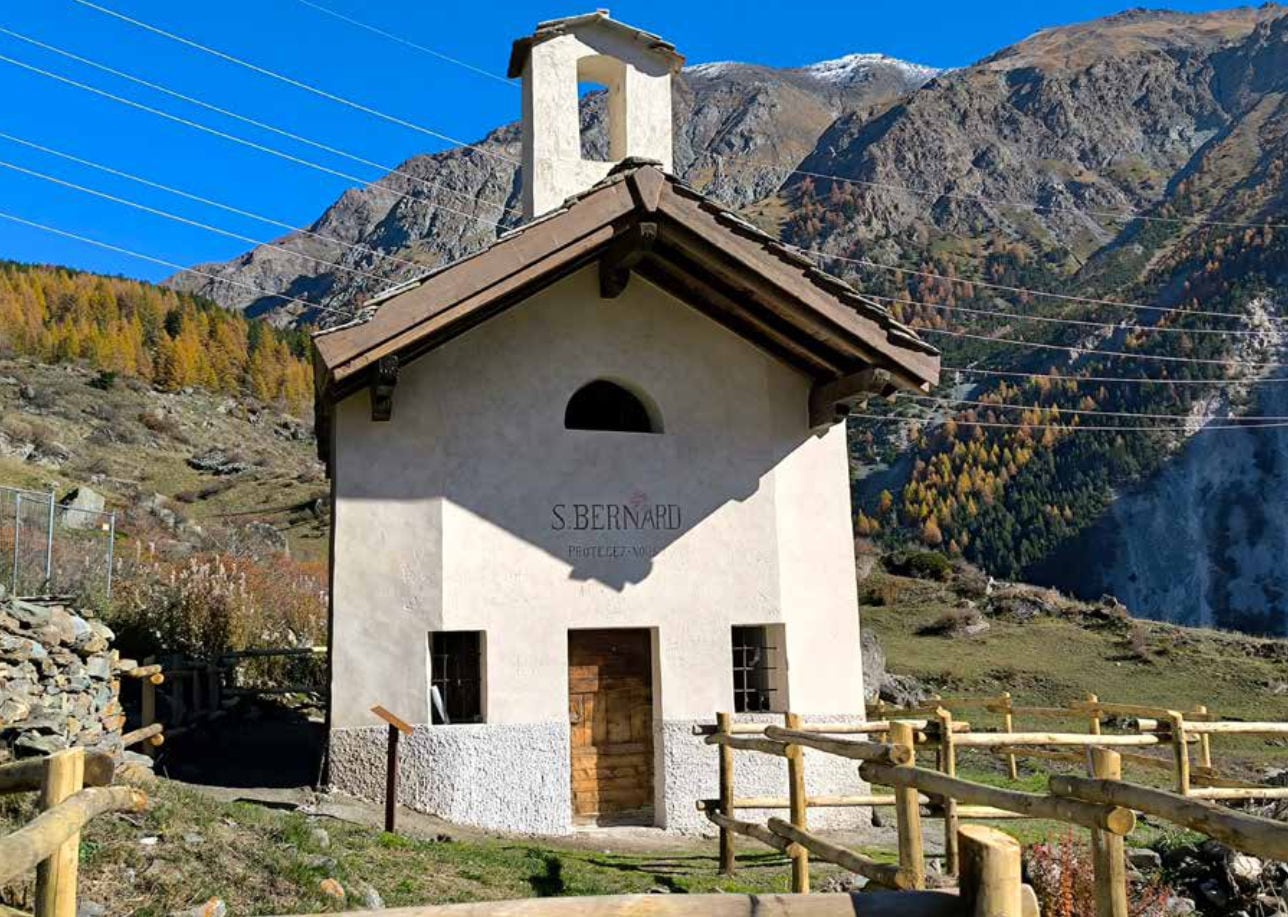
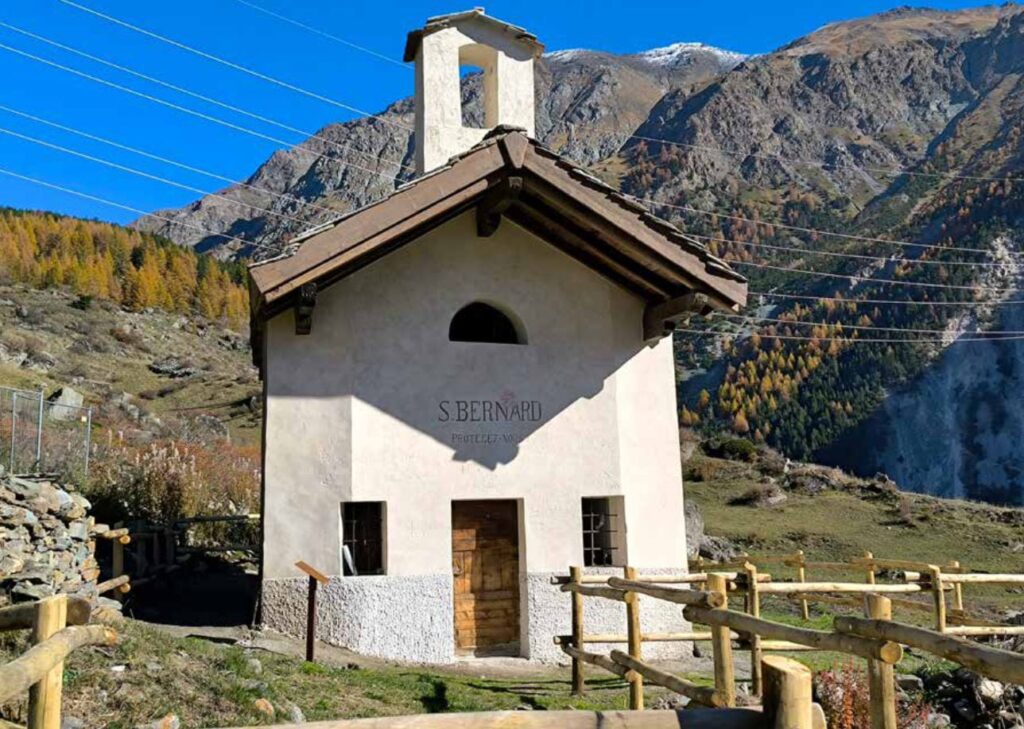
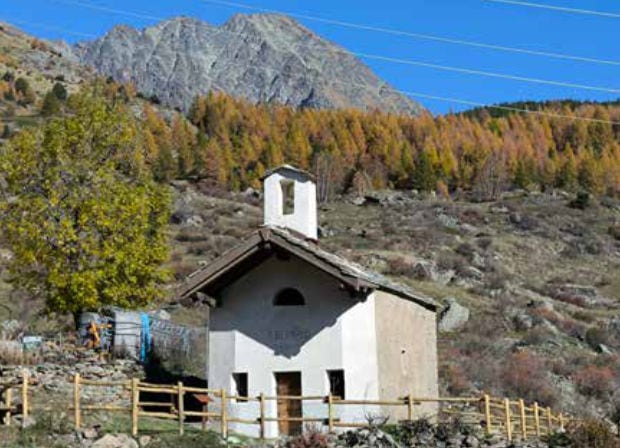
The project started in 2022 with the restoration of the chapel of San Bernardo, located in Tarabouque, which was no longer accessible. Restoration using traditional materials has made the chapel once again accessible to the community and to the visitors who want to immerse themselves in a landscape of rare beauty. Here, the views sweeps form the entrance of the Grauson Valley, with the Larsinaz mining slope, to Lillaz and Valnontey, with the Gran Paradiso and Grivola peaks.
Besides the restoration of the chapel, the project also included the recovery of an ancient path which joins the Gimillan scenic route and the valorization of other chapels, such as those in Cogne, Moline, Montroz and Gimillan. The “TSAPELLE DE COGNE” route was thus created: a historical itinerary passing by places of worship and oratories, climbing the terraces above Montroz and reaching the chapel in Tarabouque. Posters are placed in each chapel, telling the places and stories of the tradition.
The commitment to carry out the work plan was made possible thanks to the Parish of Cogne. The costs were borne by the Parish using funding from the PNRR (Missione 1 – Digitalizzazione, innovazione, competitività e cultura, Component 3 – Cultura 4.0 (M1C3), Misura 2 “Rigenerazione di piccoli siti culturali, patrimonio culturale, religioso e rurale”, Investimento 2.2: “Protezione e valorizzazione dell’architettura e del paesaggio rurale” finanziato dall’Unione europea – NextGenerationEU.), contributions from Regione autonoma Valle d’Aosta and Comune di Cogne. Last but not least, the project made possible the creation of the new Sant’Orso Parish website.


A spiritual journey between nature and history
Discover the Tsapelle of Sonveulla, Ponte della Tina, Montroz and Tarabouque.
Founded between the 16th and 17th centuries, restored in the 19th, 20th and 21st centuries, they show the perseverance in faith of the “cougnèn”. The route, which is easier in the first section up to Ponte della Tina, becomes more challenging in the second section, with an ascent of 300 meters and some flat areas along a very scenic route.
Consult the map
It is possible to consult the map of the route directly from the site by clicking on “see map”. However, we recommend downloading the map onto your device in advance, to avoid mobile network problems.
Parish of sant’Orso
COGNE CAPOLUOGO / ALTITUDINE 1535 M. SLM
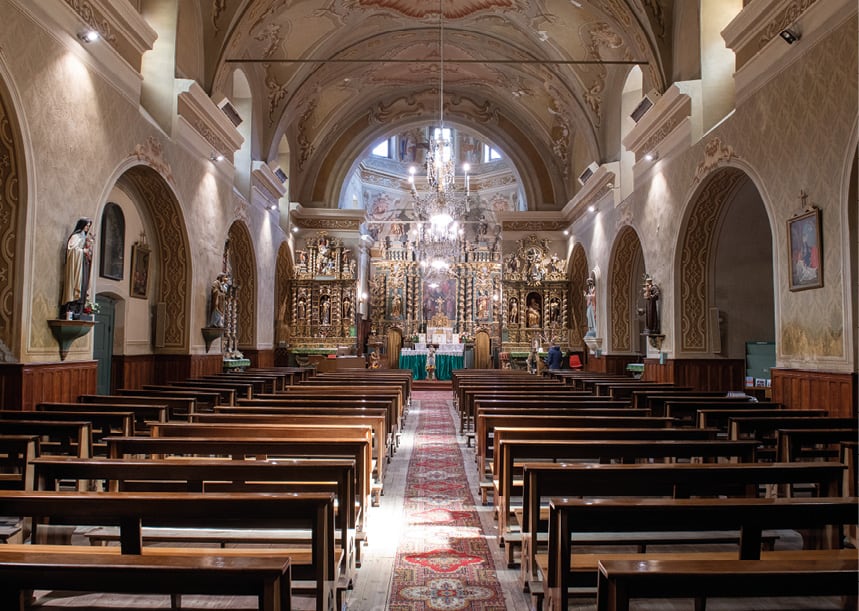
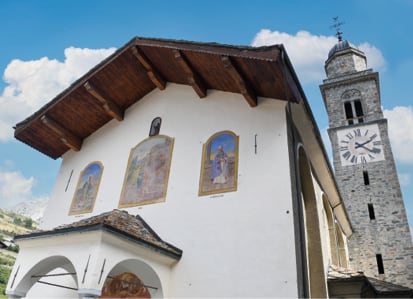
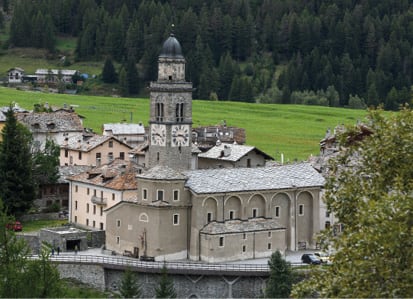
Starting from the parish church of Sant’Orso, you can discover some ancient chapels by following the signs with the ‘Tsapelle de Cogne’ logo. To reach the first chapel of the itinerary, you must cross “Desot-Veulla”, the lowest part of the village and ascend to “Sonveulla. In the local dialect sonveulla means the upper part of the village. Immediately after we pass by “Casa dell’Orologio”, the old mansion of César-Emmanuel Grappein (1772 – 1855)who was the mayor of Cogne, a great intellectual, a doctor and a man of great importance for the modern exploitation of the mines. He was responsible for the re-establishment of the exploitation of the Liconi mines in 1812, entrusting the work and the proceeds to the inhabitants of the village. From here, you take Rue Linnea Borealis, named after a rare and protected shrub in the Gran Paradiso National Park.
The Tsapelle that you will encounter were founded between the 16th and 17th centuries, restored in the 19th, 20th and 21st centuries, and they show the perseverance in faith of the “cougnèn”. The route, which is easier in the first section up to Ponte della Tina, becomes more challenging in the second section, with an ascent of 300 meters and some flat areas along a very scenic route.
Click here for the photo gallery
Chapel of Sonvilla
SONVILLA RUE DES CLEMENTINES / ALTITUDINE 1570 M. SLM
Named after St Anthony of Padua (originally St Margaret)
Patron saint: 3 February, St Blaise’s day
How to get there
Continuing the itinerary from the Sonvilla chapel to head towards Ponte della Tina, climb up Rue des Clementines (perhaps named after the feminine name historically very common in Cogne) and leave Maison Gérard-Dayné on the right, named after two historic families of Cogne, an old rural house dating back to the 17th century and now an interesting ethnographic museum.
Following the signs with the ‘Tsapelle de Cogne’ logo, we descend to the left, skirting the last houses of Sonvilla, to head along the path through the trees towards the confluence of the Urtier and Grauson torrents where the chapel of St. Anthony is located, linking up with the rue Mines de Cogne that leads to the dirt footpath in the forest that leads to Champlong and Lillaz.
The chapel is located near the communal road and bridges, the old stone bridge from the early 18th century, pedestrian only, from which you can enjoy a view of Mont Blanc, and the new bridge that connects the main town with the hamlets of Moline, Lillaz, and the hamlets higher up, up to Gimillan.
Chapel of Sonvilla
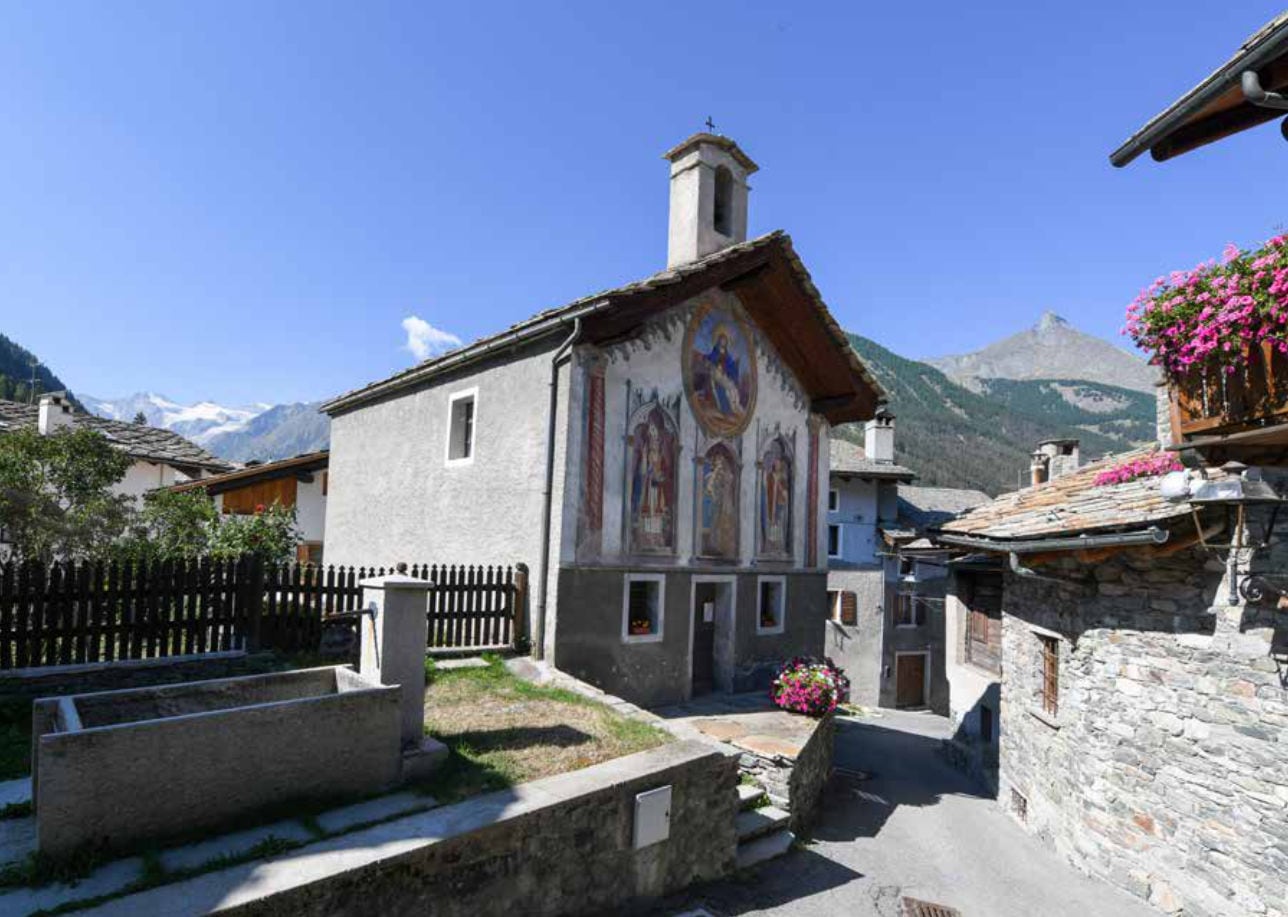
The chapel stands at the top of the village, squeezed between the houses. It suddenly offers itself to the visitor’s gaze with its beautiful painted façade. It boasts very ancient origins; it was founded in 1524 by the cathedral canon Etienne Savin, a native of Cogne, and dedicated to Saint Margaret. Already at the beginning of the 18th century, as recorded in the minutes of pastoral visits by the bishops of Aosta, the chapel was in disuse. During the French Revolution, the chapel’s assets were sold. By the beginning of the 19th century, the chapel was in ruins and the bishop of Aosta Aubriot de la Palme proceeded to ban it. Therefore, the Mass to St Margaret, instituted on 1 September 1833 by the Rev. Father, former Cordelier, Pierre-Christophe Guighardaz, was moved to the church.
The chapel was completely rebuilt by Antoine Joseph Jeantet and blessed on 13 June 1869. On that occasion, the chapel was dedicated to St Anthony of Padua, the founder’s eponymous saint, to which the bishop also added St Joseph.
Here St Blaise is celebrated as the patron saint of Sonvilla on 3 February.
The chapel was restored again in 1969.
Artistic elements
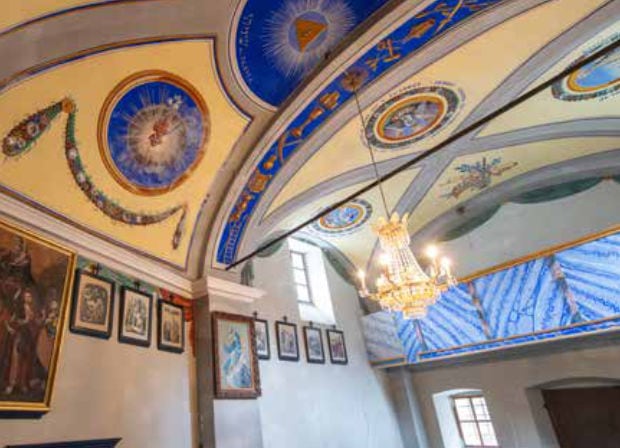
A trompe-l’oeil decoration is painted on the façade, presenting an architectural structure with two columns supporting neo-Gothic hanging arches. At the top, in a large medallion is the image of the Pietà. On the lower level, inside three niches with neo-Gothic frames, are images of St Anthony of Padua in the center, St Orso on the right, patron of the parish, and St Grato on the left, patron of the diocese. Inside, a 19th century altar in painted and gilded woods bears a painting of St Anthony with the Child Jesus in the center. On the interior vault of the choir, large medallions depict St Joseph in the center and Eucharistic symbols at the sides. On the vault of the apse is the Holy Trinity in the form of a triangle with ‘I always place the Lord before me’ (with a small spelling mistake).
Click here for the photo gallery
Chapel of Ponte della Tina
MOLINE PONTE DELLA TINA / ALTITUDINE 1542 M. SLM
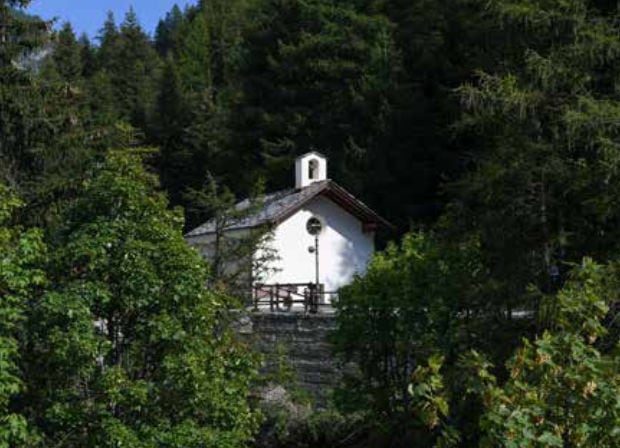
Named after St Anthony of Padua
Patron Saint 13 June
How to get there
It is worth crossing the Tina brigde over the Urtier creek, immediately downstream of the confluence with the Grauson creek, to admire the ancient stone structure and the impetuosity of the stream, which has carved out the giants’ patholes. The place-name “pon de la teunna”, in patois, is derived from these interesting “bowl” formations in the rock. A rare view of Mont Blanc can be enjoyed from the bridge. Built in stone in 1715, with a wide round archway, it is founded at the sides on two rocky boulders. It is worth remembering that both this bridge and the famous Pont d’Aël, an aqueduct bridge from the Roman era located in the municipality of Aymavilles, did not suffer the terrible flood of 1846, which destroyed as many as 16 bridges throughout the Aosta Valley. After crossing the bridge, we continue our itinerary towards the Miners’ Village: following the signs with the ‘Tsapelle de Cogne’ logo, climb up the ridge initially alongside the Grauson stream, where there are a few steps. Follow the hairpin bends of the road and past the Valle d’Aosta Mining Park and Cogne Mine Exhibition Centre, you reach the municipal road for Gimillan. On the wall of the hairpin bend before is an engraved stone commemorating the site of a 19th century chapel. From here, a few hundred meters and you reach the isolated chapel of Montroz.
Chapel of Ponte della Tina
On 23 September 1617, Jean Pantaleon Guichardaz made a bequest in favour of the chapel at Moline for the foundation of two masses: one on the day of Saint Anthony of Padua and the other on the day of the beheading of John the Baptist, to whom he also dedicated a procession on the feast of his birth. It was initially called ‘la chapelle des Guichardaz’ because it was built at the behest of this family.
In the minutes of the pastoral visit of the bishop of Aosta in 1700, the chapel is described as well-built and awaiting blessing, perhaps because recently renovated. At the end of the 19th century, it was in very poor condition and was banned from worship. It was restored and blessed in 1926 at the expense of the Mining Society and the parish. The last restoration dates back to 2012-2013 and was completed in 2014.
Artistic elements
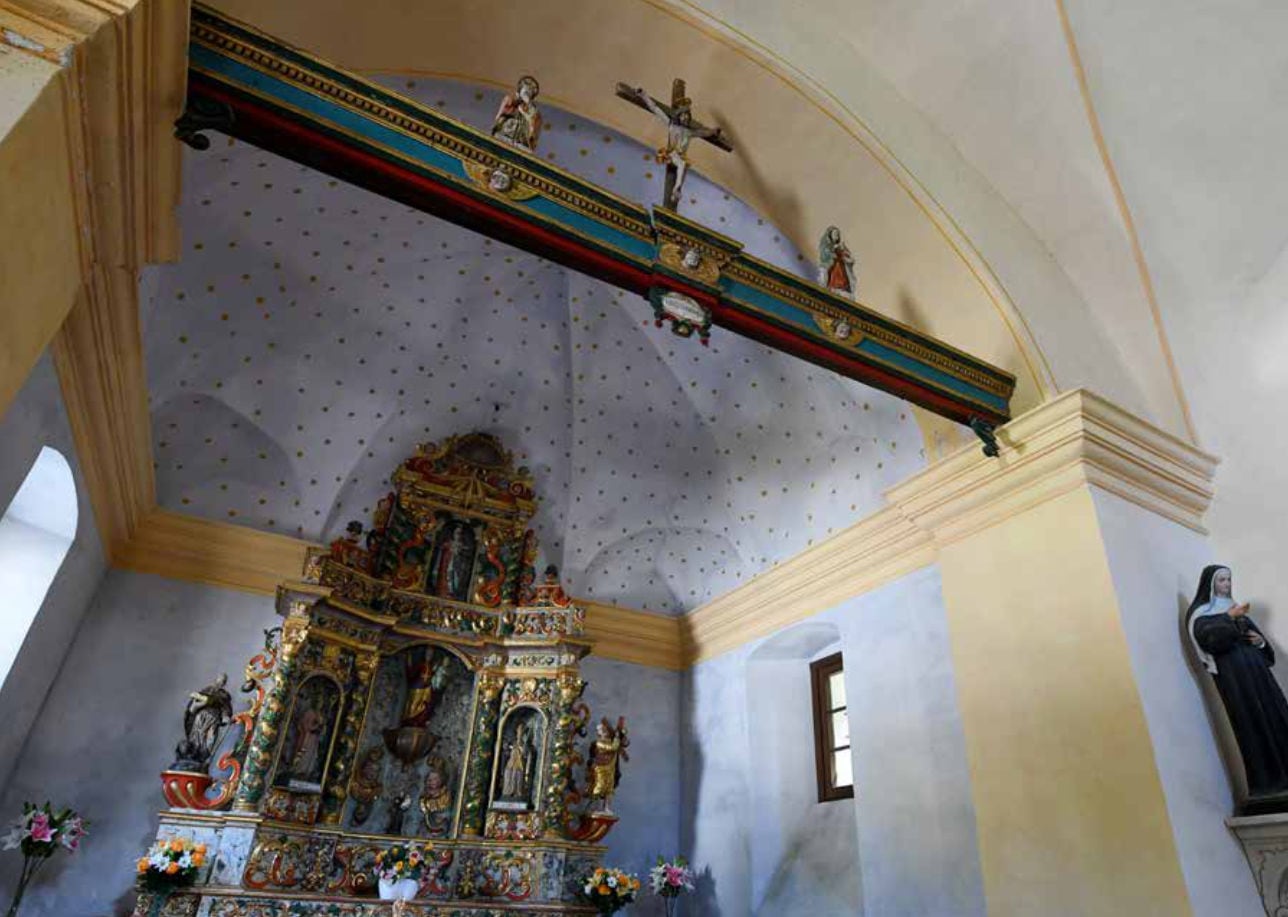
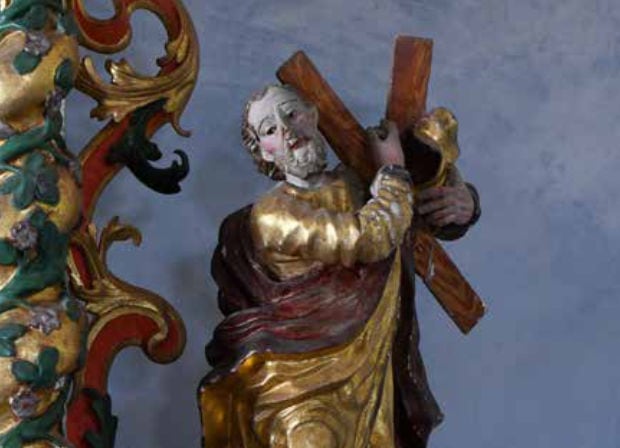
Inside, it has a very valuable wooden altar dated 1748, assignable to the hand of the Valsesia’s sculptors Gilardi. It was heavily impoverished by the thefts perpetrated in the years 1974-1975. The structure was in fact populated by a multitude of statues, including those in the central niche depicting Saint Anthony of Padua kneeling before the Child Jesus and Saints John the Evangelist and John the Baptist. In the upper register was the figure of the Madonna with the statue of the Apostle Peter and that of Saint Andrew, the only one surviving after the thefts.
Click here for the photo gallery
Chapel Of Montroz
MONTROZ / ALTITUDINE 1675 M. SLM
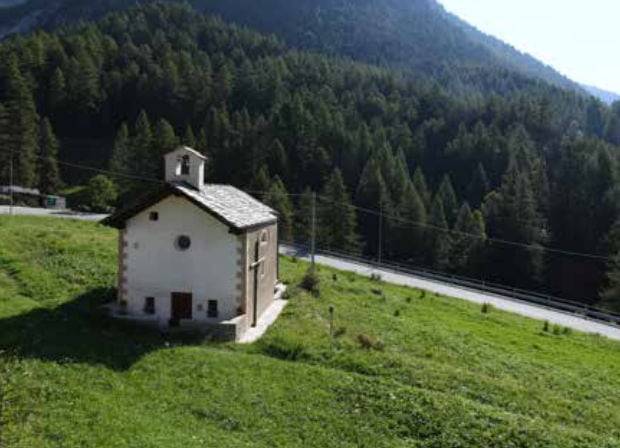
Named after Notre-Dame de Pitié
Patron saint first Wednesday after Easter
How to get there
To reach the chapel dedicated to Saint Pantaleon in Gimillan from the chapel of Notre-Dame de Pitié, cross the beginning of Montroz and climb up on the left towards the village above, along a panoramic path, in the midst of fields that were cultivated with rye in the 19th century until the mid-20th century. Cross the communal road and take the path on the left, where there is a private oratory belonging to the Jeantet family. Once you reach Gimillan, enter the hamlet keeping to the left, where there are enchanting panoramic views of Valnontey.
From Montroz, it is possible to make a detour to visit the Cogne magnetite mine, the most important in Aosta Valley. To access the mines, at the first marked hairpin bend just beyond the Montroz chapel, take the narrow road that branches off to the right to reach the Costa del Pino farmstead, in the village of the same name. From here, a carriage track leads to the mines, among the highest in Europe.
Chapel of Montroz
The foundation date of the ancient chapel of Montroz is unknown. In 1693, it was interdicted and closed to worship by the Bishop of Aosta because it was in poor condition and lacked the necessary vestments. In 1711, a new chapel was erected on the same site and on 5 April of the following year, the foundation deed was drawn up by the inhabitants of Montroz and Tarabouque. On that occasion, it was established that the patronal feast day was to be celebrated on the Wednesday after Easter. The chapel was restored in the first decade of the 21st century, with its inauguration on 8 August 2009.
A second chapel, which no longer exists today as it demolished in the first half of the 20th century, located a little further down the valley, was founded on 3 April 1821. Its patronal feast day falling on 4 May. The dedication of this new 19th-century building to Saint-Suaire took place on 18 May 1832. In the first half of the 20th century, it was in a poor state and needed extensive restoration. A stone placed on the retaining wall of the old municipal road recalls the place where this second 19th-century chapel stood, engraved with the date 1822 – at Les Bioles.
Artistic elements
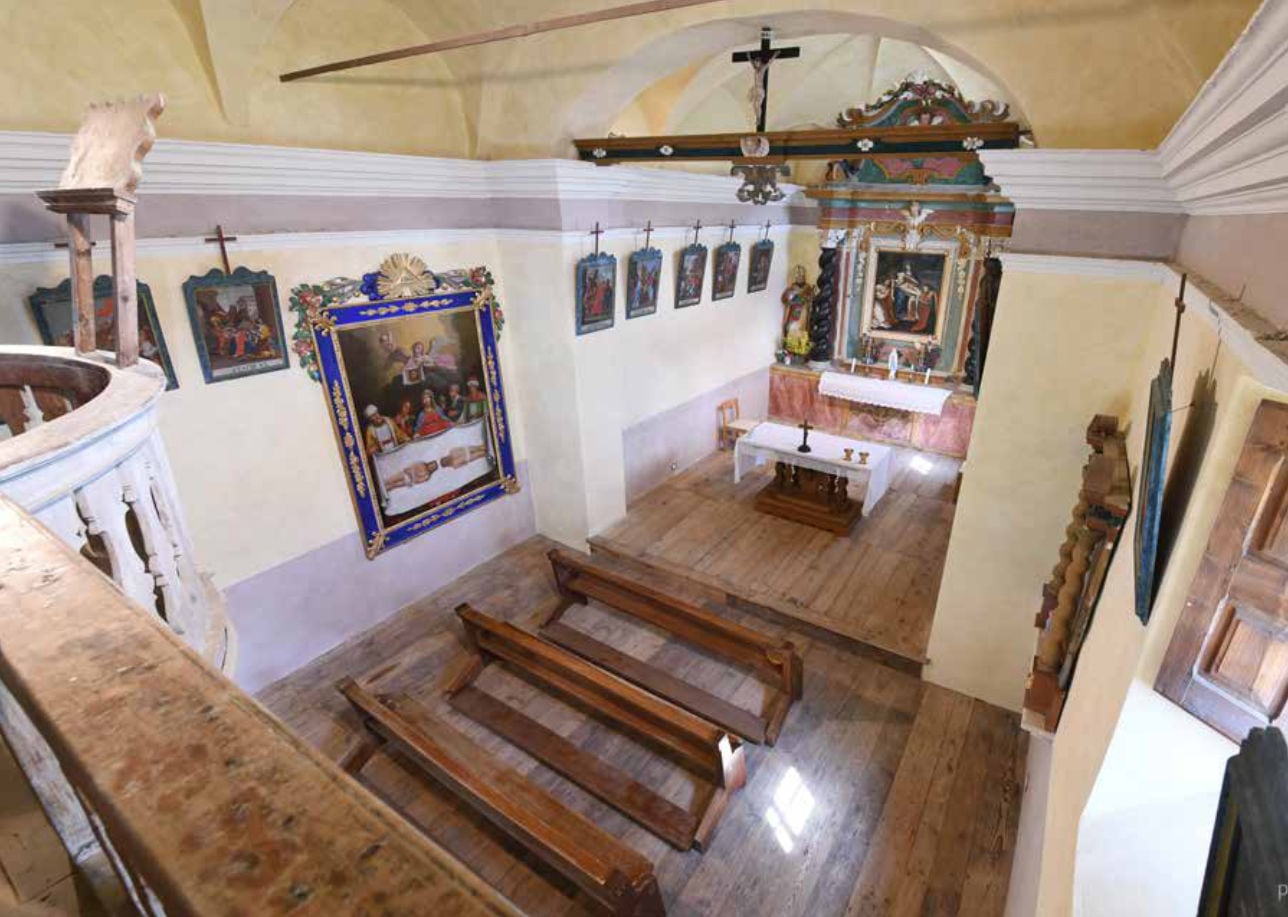
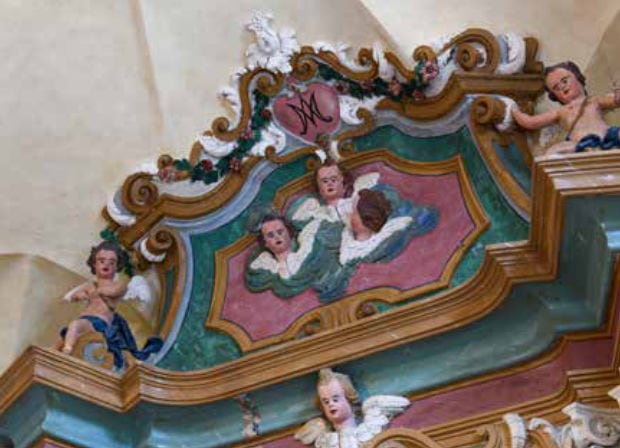
Inside, the chapel of Notre-Dame de Pitié contains a 19th-century masonry altar with imitation marble and polychrome stuccoes. On either side of the altar are statues of Saints Grato and Jocund, patron saints of the Aostan diocese. In the center is a canvas depicting Our Lady of Pity with Saint John the Evangelist and Mary Magdalene. The same subject is in the canvas of the original altar, made of wood with twisted columns, still preserved in the chapel and datable to the first quarter of the 18th century. The hall of the chapel houses a large painting of considerable interest: dating from the 19th century, it depicts the Holy Shroud supported by the Virgin, Joseph of Arimathea, Mary Magdalene, St. John and Nicodemus, with a richly painted frame. The painting came from the chapel in Les Bioles, which no longer exists.
Click here for the photo gallery
Chapel of Gimillan
GIMILLAN / ALTITUDINE 1787 M. SLM
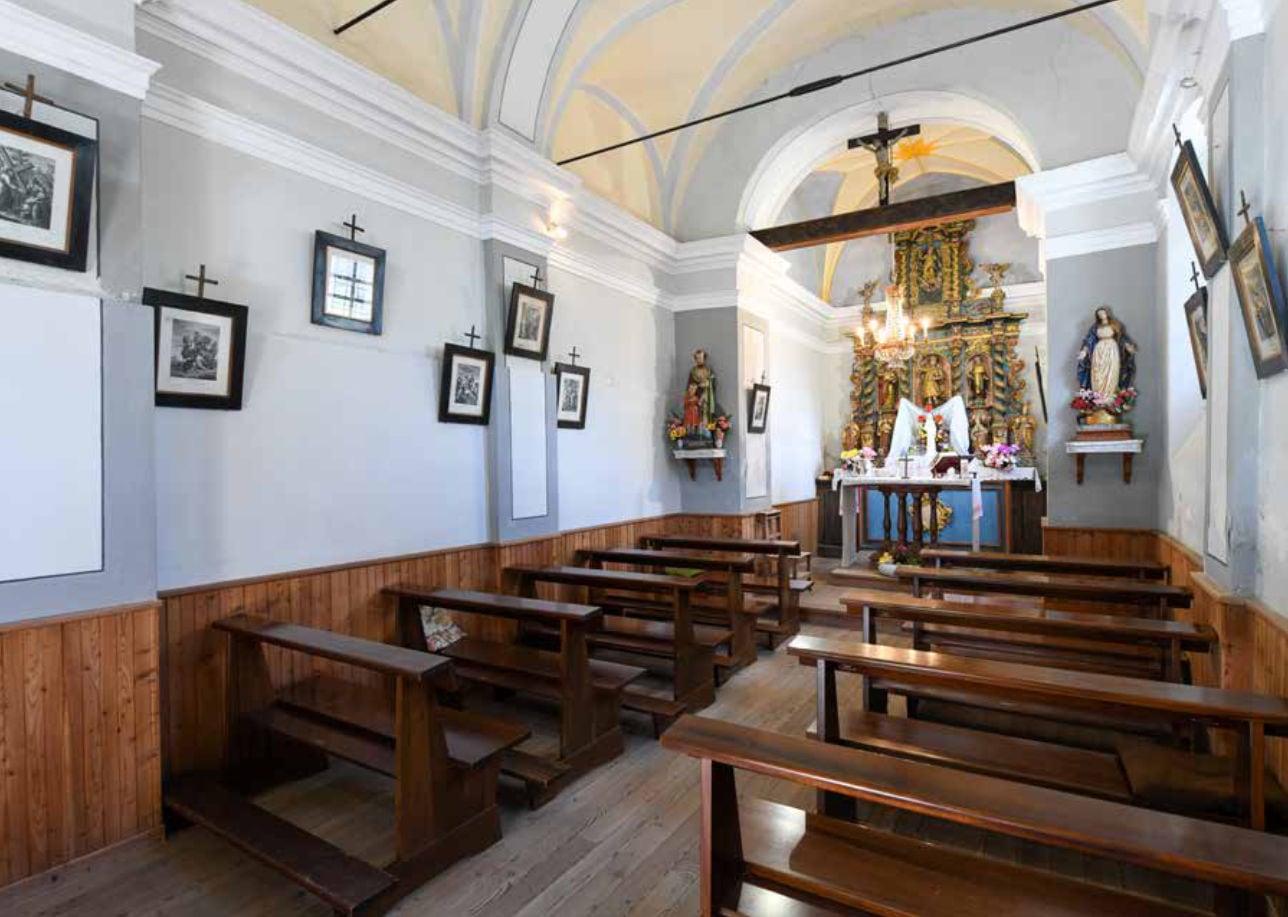
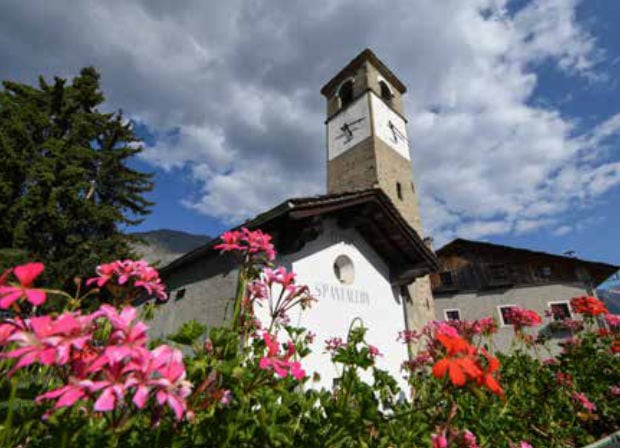
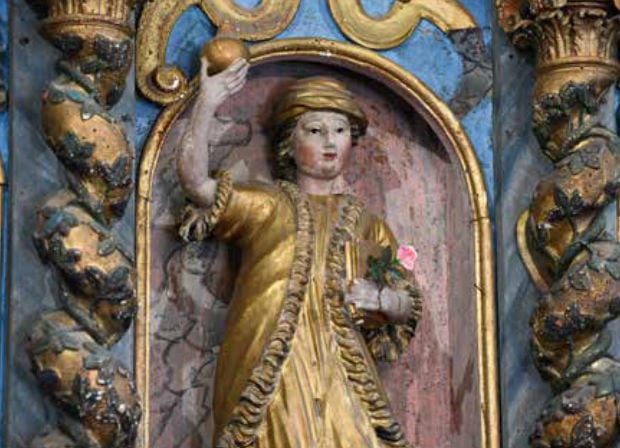
Named after Saint Pantaleon
Patron Saint 1 May
How to get there
To reach the chapel of St Bernard in the hamlet of Tarabouque, walk past the chapel of St Pantaleon of Gimillan. After the bend, descend a few metres and turn left to pass by the old village school now used as a cafeteria shop. This is where the path to the Grauson valley starts, indicated by yellow regional signs. You can also find signs for the ‘Tsapelle’ near the wooden fountain. Take the path and climb up following the signs with the ‘Tsapelle de Cogne’ logo. Walk along a section of the Gimillan panoramic path; from here turn left onto the restored old track leading to Tarabouque, arriving just in front of the chapel of Saint Bernard.
The chapel of Gimillan
The chapel of Gimillan dates back to the 17th century. We know that on 6 June 1654, two villagers, Antoine and Panthaléon Guichardaz, established a legacy for a mass in honour of Saint Pantaleon to be celebrated annually in the sacred building, built earlier by their father Antoine Guichardaz. Small in size, the chapel was probably enlarged around the turn of the century. In 1693, it had been interdicted by the bishop of Aosta because it was too attached to neighboring houses. In compliance with this indication, it is likely that it was rebuilt and enlarged soon afterwards, so that in 1700 it was well built and well decorated.
In 1819, the chapel was in very poor condition and was closed for worship in 1826. After being restored in 1845, in 1846 the villagers established a mass there, to be celebrated annually on 18 October, to invoke protection against floods and landslides. In 1859, the tall bell tower with clock was built and on 27 September 1883, it was equipped with a new bell.
It was restored again in the years 1925-’26 and again in 1980 with the re-roofing. The patron saint, who was originally celebrated on 27 July, St Pantaleon’s Day, was moved to 1 May in order to allow the employees of the nearby mine to participate on a day that was not a working day. 1 May also coincides with the feast day of St Joseph the Craftsman, established by Pope Pius XII in 1955 during the ten-year anniversary of the Acli.
Click here for the photo gallery
Chapel of Tarabouque
TARABOUQUE / ALTITUDINE 1832 M. SLM
Named after Saint Bernard of Aosta
Patron Saint 15 June
How to get there
From the chapel of San Bernardo in Tarabouque there is a stunning view of the Gran Paradiso park, the glaciers and its most important peak. It is possible to continue on the path n.8 into the Grauson valley, towards the Réventì oratory and other small shrines or more recent chapels. Every year, on the Sunday closest to the Feast of the Holy Cross (14th September), a night-time procession starts from the chapel of Gimillan, climbing up the Grauson valley, to reach the Sanctuary of the Virgin de Tout Pouvoir of Plout in Saint Marcel. The route is not technically demanding, but it is long: 23 kilometers with an altitude difference of 1,135 metres uphill and 1,972 metres downhill for a total of about 9 hours of walking. For some years now, a daytime version of the pilgrimage has also been offered for those who cannot walk all night and prefer daylight: it is called La Grande Traversée and takes place in July.
Chapel of Tarabouque
The chapel was built by the inhabitants of the hamlet on 27 November 1657. Originally, it must have been a small building with a rectangular plan. In the first half of the 18th century, in the minutes of pastoral visits by the Bishop of Aosta, it was described as always being in good condition and in 1762 it was the object of an important bequest in the will of Jean-Ours Bochet. The ridge beam of the façade bears the engraved date 1752. In 1849, the chapel was enlarged with the construction of the slightly narrower choir, visible at the back. In the years between 1927 and 1928 it was restored. On the façade, stratigraphic investigations revealed some inscriptions that had been covered by several layers of lime; in particular the one below the letters ‘NA’ of the later dedication inscription of the chapel bears the date 1780.
The original furnishings of the 17th-century chapel consisted of a canvas dated 1656 depicting St. Anthony and St. Bernard and an ancient statue of St. Bernard, now kept in the parish. The current wooden altar, painted and gilded, seems to date from the 17th century, with the statue of St. Bernard in the central niche, accompanied on either side by those of Saints Margaret and Agatha. In the cymatium at the top is a statue of the Virgin with Saints Anthony and John the Evangelist.
Between history and legend
A famous legend is linked to the chapel of St Bernard of Aosta in Tarabouque. Every year in spring it was customary for a procession to go up to the chapel, but each time the devil delighted in capturing the last believer in the line. Saint Bernard decided to place himself at the back of the procession and when the devil approached, he threw his blessed stole around his neck, which, in the face of the devil’s attempt to wriggle out, turned into an iron chain and forced him to sink into an abyss.
The story of the ‘Bèquet de Tarabouque’ is also intertwined with the history of mining exploitation. According to tradition, when the Sardinian government granted foreigners the exploitation of the Larsinaz lode in 1854, discontent soon began to spread among the local workers, who complained about the disrespectful and socially insensitive treatment of the place by these foreign industrialists. The protest materialized. Overnight, the conspirators went up to the mine (1,899 m) and burnt all the sledges used to transport the ore; from Cogne, although they saw the high flames coming from the mine, no one moved. The company reported the fact to the magistracy in Aosta who, believing in a revolt, sent all the possible carabinieri and two companies of bersaglieri to Cogne. The examining magistrate interrogated the numerous suspects who all revealed that the perpetrator of the crime had been the ‘Bèquet de Tarabouque’, the devil of Tarabouque in the patois of Cogne; not understanding the local dialect, the investigators thought it was a gang leader. In short, the soldiers led to the little church burst in, believing they would find the criminals there, but instead they only saw the statue of St Bernard with the ‘bèquet’ chained up.
Click here for the photo gallery (the restauration)
Click here for the photo gallery (the altar)
Pellegrinaggio verso Saint-Marcel,
al Santuario di Plout
Da sempre il vero pellegrinaggio è notturno e si svolge tutti gli anni la seconda domenica di settembre in concomitanza con la Festa di Santa Croce a Saint-Marcel.
Pellegrinaggio notturno di settembre
Non solo i cogneins partecipano al pellegrinaggio, ma dal 2007 si sono aggregati infatti anche dei pellegrini provenienti da Saint-Marcel o altri comuni della Valle d’Aosta.
Per loro il ritrovo è alle 21 al parcheggio dell’area Pocher di Saint-Marcel da dove raggiungono Gimillan in pullman per poi aggregarsi ai cogneins. Il ritrovo per i pellegrini di Cogne è fissato per le 22 alla Cappella di Saint-Pantaléon a Gimillan attrezzati di pila frontale e buona volontà. La camminata durerà tutta la notte con soste al Rifugio Grauson, La Petite Chaux e Chuc e arrivo al Santuario di Plout domenica verso le 9. Giusto il tempo di una colazione all’Antica Rettoria, poi, alle 10,30, è prevista la messa. Il percorso non è tecnicamente impegnativo, ma lungo: i chilometri da percorrere sono 23 con un dislivello di 1.135 metri in salita e 1.972 metri in discesa per un totale di circa 9 ore di cammino. La giornata continuerà poi in festa con un pranzo sociale.
La Grande Traversée, la diurna di luglio
Da qualche anno si propone anche una versione diurna del pellegrinaggio per chi non riesce a camminare tutta la notte e preferisce la luce del giorno: si chiama La Grande Traversée.